


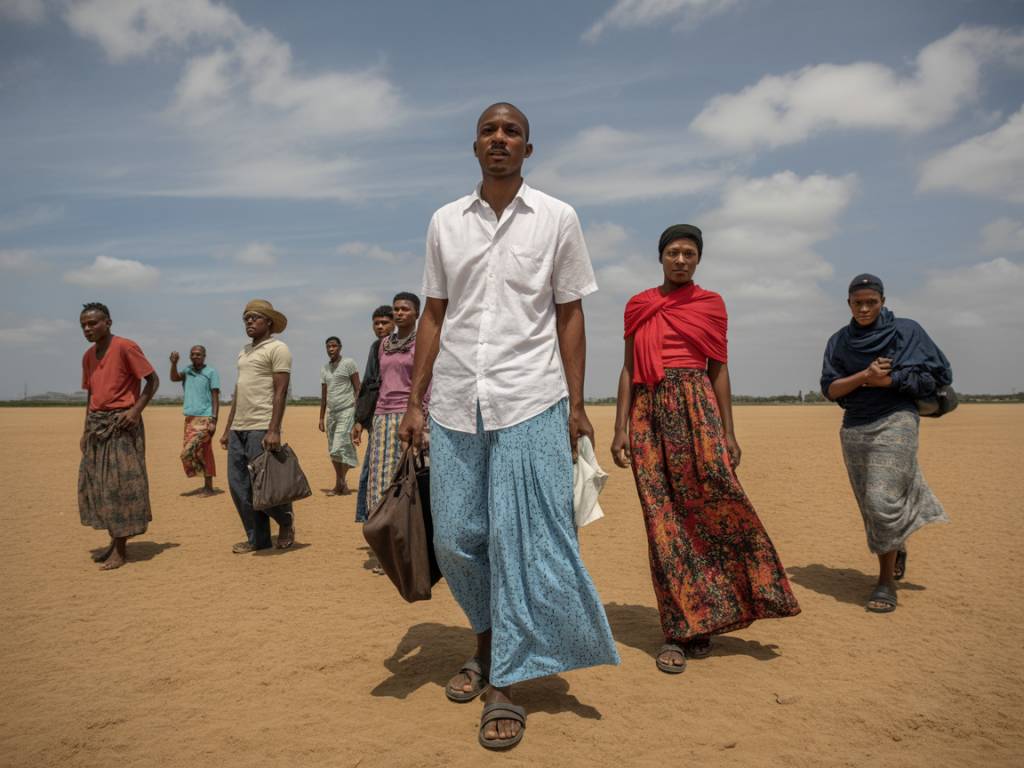
From quiet frustration to open challenge
For decades, debates about the “international economic order” sounded abstract, réservés aux diplomates, économistes et banques centrales. That era is over. From New Delhi to Brasília, from Pretoria to Jakarta, leaders of the Global South are now saying it clearly: the current system is not delivering, and they are no longer willing to simply adapt.
At the G20, within the IMF and the World Bank, through the BRICS+ group or South-South forums, one message comes back: the rules set in the second half of the 20th century are misaligned with today’s economic reality. Emerging and developing economies represent more than half of global GDP in purchasing power terms and over 80% of the world’s population, yet they still operate under financial norms, governance structures and risk models written largely by and for the Global North.
Why is this challenge accelerating now? And what does it mean, concrètement, for companies, investors and policymakers in Europe and beyond?
The three pillars of discontent
The demands for a new economic order are not just ideological. They are anchored in three very concrete frustrations that come up in every major summit:
- Debt: a system perceived as pro-cyclical, expensive and dominated by a few rating agencies and lenders.
- Trade: a “rules-based order” that often looks, from the South, like an asymmetric order favouring those who wrote the rules.
- Climate and development finance: promises of hundreds of billions that translate into slow, complex and conditional flows on the ground.
Each of these pillars is now being openly contested – not just in speeches, but through new institutions, new alliances and, increasingly, new financial tools.
Debt: when orthodoxy meets reality
Historical orthodoxy has been simple: markets and ratings decide the cost of capital; the IMF ensures macro-stability; countries in difficulty adjust their budgets and structures. In theory, discipline today means growth tomorrow.
On the ground, the story is less linear. According to the World Bank, about 60% of low-income countries are now in or near debt distress. Many are forced to devote more than a quarter of their public revenues to servicing debt – often in foreign currency – instead of investing in health, education or infrastructure.
Three recurrent complaints are driving the pushback:
- “One-size-fits-all” adjustment: governments argue that the same recipes – austerity, sudden subsidy cuts, rapid liberalisation – are applied across very different contexts, often with high social and political costs.
- Short memories, long consequences: some leaders point to the 1980s Latin American crisis or the 1997 Asian crisis, arguing that the adjustment burden fell disproportionately on citizens, while global lenders recovered much of their exposure over time.
- The power of ratings: a downgrade by one of the big three rating agencies can instantly raise borrowing costs by several percentage points, regardless of a country’s development needs or climate vulnerabilities.
This is why the “debt architecture” has become a central battlefield. Initiatives such as the G20 Common Framework for Debt Treatments have been criticised by African and Asian governments as slow and creditor-driven. Zambia’s multi-year restructuring saga has become a textbook example of what they no longer want: long negotiations, diverging creditor interests, and an economy in limbo.
The push from the South is clear: more automatic, faster and more inclusive mechanisms, where private creditors, multilateral banks and new lenders (notably China) share the burden in a transparent way – and where growth and investment are not sacrificed for a decade in the name of orthodoxy.
Trade and industrial policy: the return of double standards
The second area of friction is trade. The traditional narrative of the global system has been: open markets, free trade, minimal state intervention. Yet over the past five years, three trends have radically changed perceptions in the Global South:
- U.S.–China rivalry: export controls, tariffs, and industrial policies on both sides of the Pacific have shown that even the largest economies depart from strict free-trade doctrine when strategic interests are at stake.
- Subsidy races: the U.S. Inflation Reduction Act and the EU Green Deal Industrial Plan mobilise hundreds of billions in support for clean tech, batteries and semiconductors – essentially “green industrial policies” in advanced economies.
- Supply chain reconfiguration: “de-risking”, “friendshoring” and strategic autonomy strategies risk marginalising some developing exporters, particularly in basic manufacturing.
From Brasilia to Dhaka, policymakers ask a simple question: if rich economies can use tariffs, subsidies and strategic planning to protect and transform their industries, why should developing countries be lectured when they do the same?
This is fuelling a renewed appetite for industrial policy in the Global South: local content requirements, state-backed credit for strategic sectors, renegotiation of trade agreements, and stronger regional blocs such as the African Continental Free Trade Area (AfCFTA) or Mercosur 2.0.
For decades, the orthodoxy was: liberalisation first, industrial policy later (maybe). The new discourse is almost the opposite: strategic industrial capacity first, then gradual integration into global markets on more equal terms.
Climate finance: promises, gaps and new alliances
Climate is perhaps the most visible area where the demand for a new order has crystallised. The numbers are well known: emerging and developing economies (excluding China) need an estimated 2,000 to 2,400 billion dollars per year by 2030 in climate and development investments. Public flows currently cover only a fraction of that amount.
From the perspective of the South, the equation looks like this:
- Rich countries have built their prosperity on two centuries of high emissions.
- They now ask poorer countries to follow a low-carbon path that is more expensive in the short term.
- Yet the promised financial and technological support remains below what was announced – and is often tied to complex conditionalities.
The now-famous pledge of 100 billion dollars per year in climate finance, first made in 2009, was only (almost) reached more than a decade later, and even then mainly through loans rather than grants. At the same time, many vulnerable countries pay more in interest on their external debt than they receive in climate-related support.
Hence the growing insistence, in forums from COP to the Paris Summit for a New Global Financing Pact, on three demands:
- Massive scaling-up of concessional finance (low-rate, long-maturity loans and grants) for mitigation and adaptation.
- Reform of multilateral development banks so they take more risk, leverage more private capital and align their portfolios with climate and development goals.
- Compensation mechanisms such as the “loss and damage” fund for countries hit hardest by climate impacts.
Some governments now link these demands directly to broader economic governance. The argument: if the system cannot finance a fair climate transition, then its rules, mandates and governance must change.
New tools: BRICS+, local currencies and alternative payment rails
The dissatisfaction with the current order would remain rhetorical if it was not translating into concrete alternatives. Over the past decade, several parallel initiatives have emerged:
- New financial institutions: the New Development Bank (NDB) created by the BRICS, the Asian Infrastructure Investment Bank (AIIB), and a growing ecosystem of regional development banks in Africa, Latin America and Asia.
- De-dollarisation debates: while the dollar remains dominant (around 58% of global FX reserves), its share has been slowly declining. More trade is being settled in yuan, rupees, roubles or local currency pairs, especially between China, Russia, India and some African and Latin American partners.
- Payment system diversification: alternative messaging systems to SWIFT, regional payment platforms like the Pan-African Payment and Settlement System (PAPSS), and experiments with central bank digital currencies (CBDCs) for cross-border settlements.
The objective is less about abruptly replacing the existing order than about reducing vulnerability to unilateral sanctions, exchange rate shocks and liquidity shortages. For many countries, dollar dependence means importing U.S. monetary policy and financial volatility without having a say in it.
Will a BRICS currency emerge? For now, it remains politically and technically complex. The real shift is more incremental: a world where a larger share of South-South trade and investment no longer passes systematically through dollar-based circuits.
Governance and voice: who sets the rules?
Behind financial and trade mechanics lies a more political question: who decides? In institutions like the IMF and the World Bank, voting power and leadership have long reflected the post-1945 balance. While reforms have slightly increased the weight of some emerging economies, many countries still feel under-represented compared to their demographic and economic weight.
Two recurring demands illustrate this:
- Quota and voting reforms at the IMF and World Bank, giving more influence to fast-growing economies and under-represented regions.
- End of informal conventions such as the tradition that the IMF head is European and the World Bank president is American.
Beyond Bretton Woods institutions, the same logic spills over into global standard-setting: Basel banking rules, OECD tax frameworks, digital regulation, AI governance. Many Global South governments argue that standards defined without them often fail to account for their constraints and priorities.
Hence the proliferation of alternative or complementary forums: BRICS+, expanded G20 outreach, African Union’s entry into the G20, as well as coalitions of vulnerable states on climate, debt or taxation. The goal is to turn a historical “receivers’ club” into a more balanced “rule-making” arena.
Implications for businesses and investors
For companies and financial institutions, this slow-motion reconfiguration is not just a diplomatic story. It reshapes risk, opportunity and strategy in several ways.
1. More fragmented, but also more contestable, markets
As regional blocs strengthen and industrial policies multiply, market access conditions will become more heterogeneous. Local content rules, new screening mechanisms for foreign investments, and changing tariff regimes will require closer political and regulatory monitoring.
At the same time, ambitious industrial and climate plans in the Global South will create demand for technology, equipment, expertise and capital. Firms able to adapt their models – partnering with local players, sharing know-how, co-investing in infrastructure – will find significant growth avenues.
2. New financial partners and instruments
Development finance is no longer the monopoly of a few Western-led multilaterals. A project in Africa or Asia can now be co-financed by a mix of World Bank, African Development Bank, AIIB, NDB, Gulf sovereign funds and local development banks. For corporates and investors, this means more potential sources of blended finance – but also more complex negotiations and governance structures.
Green bonds, sustainability-linked loans and transition finance instruments are also becoming central to the South’s development agenda. Knowing how to structure and certify these instruments in line with local and international standards will be a competitive advantage.
3. Currency and payment diversification
If more trade flows are settled in local currencies or via alternative payment systems, treasury and risk management functions will need to evolve. Hedging instruments may be less liquid or more expensive in some currencies, but they will also open room for differentiated pricing and long-term partnerships.
Companies heavily reliant on dollar-based contracts in emerging markets should anticipate discussions on currency diversification – sometimes driven as much by politics as by economics.
What next? Three scenarios to watch
Where does this all lead? The global economic order will not be rewritten overnight, but several trajectories are taking shape.
Scenario 1: Gradual reform from within
Under this scenario, mounting pressure from the South – combined with the need to stabilise a fragmented world – pushes existing institutions to adapt. IMF and World Bank quotas are rebalanced, climate and development mandates are strengthened, debt mechanisms become more predictable, and more space is given to South-led initiatives within the existing framework.
Result: the system remains recognisable, but its centre of gravity shifts. For businesses, the rulebook becomes somewhat more inclusive, though still complex.
Scenario 2: Parallel blocs and selective decoupling
Here, mistrust between major powers – and slow reforms – accelerate the creation of almost parallel systems: competing payment networks, divergent regulatory standards, regional financial safety nets. BRICS+, the G7, and other blocs each cultivate their own tools, alliances and industrial strategies.
Result: businesses navigate a more fragmented landscape, with higher compliance and geopolitical risks, but also opportunities to arbitrage between regimes.
Scenario 3: Crisis-driven rupture
In this less favourable scenario, a major debt, climate or financial shock exposes the limitations of the current architecture. Uncoordinated responses, capital controls, abrupt devaluations and trade restrictions could trigger a more chaotic reconfiguration.
Result: uncertainty spikes, and both North and South rediscover – brutally – the cost of underinvesting in a fair and resilient global order.
How decision-makers can respond now
Waiting to see which scenario prevails is tempting but risky. Several pragmatic steps are already within reach for governments, institutions and companies.
- Integrate “Global South politics” into strategy, not just risk. Follow not only elections and crises, but also emerging coalitions, regional initiatives and industrial policies that will shape regulation and demand.
- Develop genuine partnerships. Move from transactional projects to long-term alliances with local institutions, universities, startups and public agencies, especially in energy, digital and infrastructure.
- Strengthen internal capacity to manage regulatory diversity. Legal, compliance, ESG and strategy teams need to work together to map how different blocs are evolving on climate, data, taxation and competition.
- Experiment with new financial tools. Blended finance, guarantees, local currency instruments and innovative risk-sharing mechanisms can make projects viable where traditional models fail.
- Engage in standard-setting debates. Businesses that participate early in discussions on green taxonomies, digital rules or AI frameworks in the South can help shape realistic, interoperable standards – and avoid future fragmentation costs.
The demand for a new economic order is not a passing diplomatic slogan. It is the expression of a structural shift: a world where demographic, economic and climate realities no longer match institutional and financial arrangements built in another era.
For leaders in business and public policy, the key question is less “Can we resist this change?” than “How do we help steer it in a direction that is both fair and workable?” The companies and countries that will remain relevant are likely those that treat this transformation not as a threat to defend against, but as a negotiation to engage in – with facts, capital, and a genuine willingness to share power.