


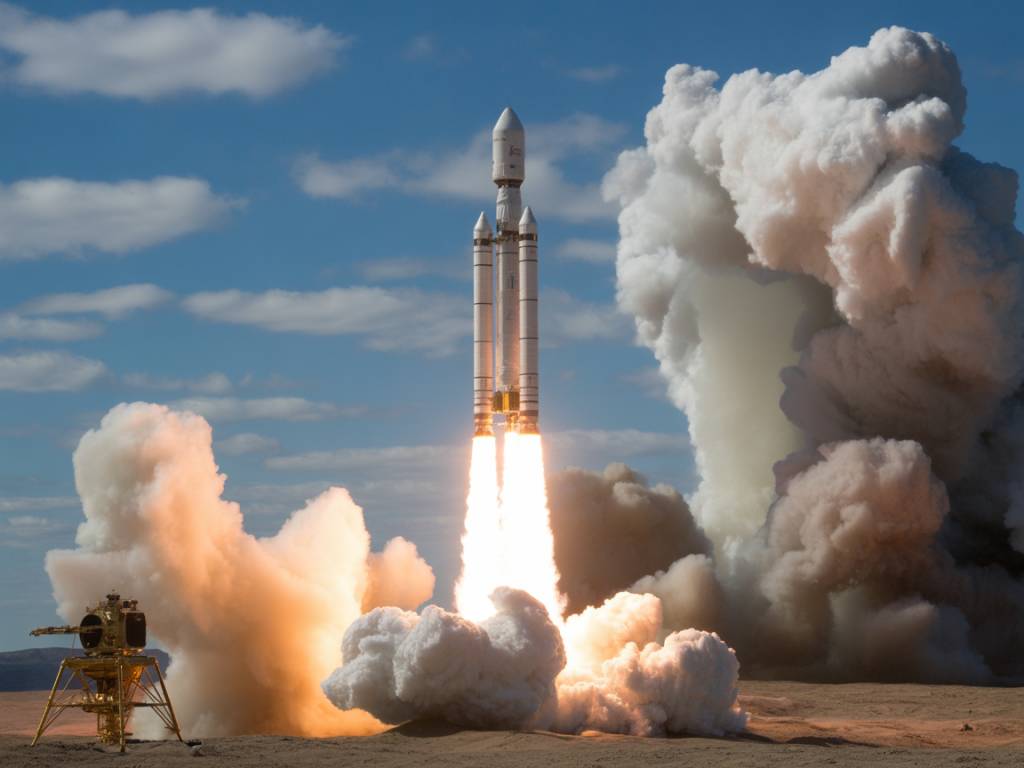
The space race is back. But this time, it is not about planting a flag on the Moon. It is about control over data, infrastructure, raw materials, and strategic advantage — with direct implications for global power balances and daily life on Earth.
From mega-constellations of satellites to lunar mining projects, space has become a business, a battlefield, and a regulatory headache. The United States, China, Europe, India and a growing club of newcomers are investing billions in rockets, orbital platforms and exploration programs. Private actors — SpaceX, Blue Origin, Starlink, OneWeb, Planet, Astroscale, to name a few — are reshaping an ecosystem once dominated by states.
What does this new space race really change for geopolitics, and for citizens who never plan to leave the planet? A lot more than you might think.
From symbolic competition to infrastructure race
The first space race (1957–1975) was symbolic: who would be first in orbit, on the Moon, in terms of technological prestige? Today’s race is infrastructural and economic.
Three major shifts explain this change:
- Lower launch costs: The cost of putting 1 kg into low Earth orbit has dropped from around $20,000 in the 1990s (Space Shuttle) to under $2,000 with reusable rockets like Falcon 9, and is expected to fall further with new vehicles such as Starship.
- Miniaturisation of satellites: CubeSats and smallsats enable constellations of hundreds or thousands of units instead of a few large, very expensive satellites.
- Commercialisation of services: Communications, imaging, navigation, weather, cybersecurity: space has become an enabler for a long list of B2B and B2G services — and a huge potential market.
In practice, this transforms space into a strategic layer of infrastructure, comparable to undersea cables or energy grids. Whoever controls this layer controls critical flows of information and services. That is where geopolitics comes in.
Geopolitics in orbit: power, alliances and fault lines
Space has become a new arena for competition between major powers, with at least four key fault lines.
1. United States vs. China: the central rivalry
The US remains the space leader in terms of budget (over $60 billion public spending per year if you include NASA, Space Force and other agencies) and private investment. SpaceX alone has put more objects into orbit than most countries combined. The US also leads in navigation (GPS), planetary exploration, and the commercial launch market.
China, however, has built a full-spectrum space capability in two decades: independent launchers (Long March), a modular space station (Tiangong), lunar and Martian missions, anti-satellite tests, and ambitious programs for the far side of the Moon and potential resource exploitation. Beijing frames space as a pillar of its “great rejuvenation” and as a strategic domain on par with sea and cyberspace.
Both countries now structure alliances around space. The US promotes the Artemis Accords, a legal and political framework for lunar exploration and resource use, signed by more than 30 states (including many European and Asian allies). China and Russia push for alternative frameworks, such as the planned International Lunar Research Station (ILRS), with partners including some BRICS members.
Behind legal debates on “peaceful use” of outer space, the question is simple: who sets the rules and gets access to key orbits and resources?
2. Europe’s strategic dilemma
The European Union and ESA countries still have significant capabilities (Ariane rockets, Galileo navigation system, Copernicus Earth observation program), but they are under pressure:
- Ariane 5 has been retired, and Ariane 6’s delays have temporarily reduced Europe’s autonomous access to space.
- Sanctions on Russia have cut off access to Soyuz launches, which Europe used for medium payloads.
- Private European launchers and constellations (e.g. ArianeGroup, Arianespace competitors, startup launchers, IRIS² for secure connectivity) are still catching up with US players.
This exposes a strategic vulnerability: Europe depends on non-European launchers — particularly SpaceX — for certain missions. For a continent that talks about “strategic autonomy”, relying on an American private company for key satellites is a complex position.
3. Militarisation and “space as a warfighting domain”
Space is officially a domain of military operations for NATO and several states (US, France, UK, Japan, India, among others). The concerns are clear:
- Anti-satellite missiles (ASAT), tested by Russia, China, India and the US, can destroy or blind critical satellites.
- “Co-orbital” systems can approach, inspect, jam or damage another country’s space assets.
- Cyberattacks can target ground segments of space systems — as seen with the 2022 Viasat hack, just as Russia invaded Ukraine.
Satellites are no longer neutral infrastructure: they are both strategic assets and potential targets. This changes how conflicts are planned and deterred — and increases the stakes of space governance.
4. A crowded and contested orbit
Low Earth orbit (LEO) is filling up fast. As of 2024, over 9,000 active satellites are in orbit, and projections suggest there could be 60,000–100,000 by 2030, largely due to mega-constellations like Starlink, OneWeb and future Chinese and European constellations.
This raises three interlinked risks:
- Collisions and debris: Each collision can generate thousands of debris fragments, increasing the risk of a chain reaction (the “Kessler syndrome”) that could make some orbits temporarily unusable.
- Orbital congestion: Satellite operators must constantly adjust orbits to avoid close approaches. In 2019, ESA had to move a satellite to avoid a Starlink unit after failed coordination.
- Regulatory tensions: National agencies assign frequencies and altitudes, but there is no global air-traffic-control equivalent for space. This leaves room for unilateral behaviour and diplomatic frictions.
In short, space governance is lagging behind technical and commercial realities, and that gap has geopolitical consequences.
Everyday life: invisible dependence on space systems
For most people, space still evokes rockets and astronauts. In reality, it already shapes daily life in less visible — but critical — ways.
Navigation and timing: the hidden layer behind modern logistics
GPS (US), Galileo (EU), BeiDou (China) and GLONASS (Russia) do much more than guide cars. They provide precise timing signals used by:
- Financial systems (timestamping high-frequency trades and transactions)
- Telecom networks (synchronising mobile antennas and data centres)
- Electricity grids (balancing loads between regions)
- Ports, airports and logistics platforms (tracking and sequencing flows)
A major disruption of satellite navigation would not just affect your rideshare app. It could destabilise financial markets, degrade mobile networks and slow down global trade. This is one reason why large powers develop their own systems instead of relying on foreign ones.
Connectivity: from remote villages to war zones
Satellite internet used to be slow, expensive and niche. Mega-constellations have changed the equation:
- Starlink has over 5,000 satellites in orbit and more than 2 million users worldwide, with performance comparable to or better than terrestrial broadband in many rural zones.
- OneWeb focuses on B2B and government connectivity, especially for remote infrastructure (offshore sites, aviation, maritime).
- Chinese and Indian actors are preparing their own LEO constellations, while the EU’s IRIS² aims at secure connectivity for governments and critical sectors.
The political significance of this became explicit in Ukraine: Starlink has been used to keep communications running in bombed areas, support drones, coordinate military units and maintain civil services. Access to a privately operated constellation became a strategic variable in a major war.
For citizens and businesses, satellite connectivity is also a tool against the digital divide. Remote sites, mines, wind farms, agricultural operations, tourist facilities or ships can now access high-bandwidth connections without terrestrial infrastructure. This opens new business models — but also raises questions about dependence on a few powerful private operators.
Earth observation: seeing, measuring, anticipating
Hundreds of satellites image the Earth every day, across multiple spectra. Their data feed:
- Weather forecasts and extreme event alerts
- Agricultural monitoring (yield estimation, irrigation, soil moisture)
- Forest and fire surveillance
- Urban planning and infrastructure monitoring
- Insurance and risk assessment (floods, storms, fires)
For businesses, the combination of satellite imagery, AI and field sensors enables new services: precision agriculture, supply-chain risk scoring, climate-risk analytics, maritime route optimisation, illegal fishing detection, and more. Startups like Planet, Spire or ICEYE sell daily (or even hourly) views of specific sites to clients ranging from governments to hedge funds.
The same tools also feed open-source intelligence (OSINT). Journalists and NGOs now use commercial satellite imagery to verify claims about troop movements, infrastructure damage or human rights abuses. This changes the information balance in conflicts and authoritarian contexts.
Climate and environment: space as a global sensor
Space is indispensable for understanding and managing climate change. Satellites monitor:
- CO₂, methane and other greenhouse gas emissions
- Ice sheet evolution and sea level
- Ocean temperature and currents
- Deforestation and land-use change
Programs like Europe’s Copernicus provide vast amounts of open data that companies and public actors use for climate models, adaptation planning, ESG reporting and environmental compliance. Expect regulatory pressure to increase: more precise and frequent data makes it harder to hide emissions or greenwashing practices.
Business opportunities: from launchers to data platforms
The new space race is not only a state affair. It is also a rapidly expanding market, with several layers of value.
Launch and in-orbit services
At the base, someone has to put objects into orbit. Today, this is dominated by a few key players (SpaceX, China’s CASC, Russia’s Roscosmos, Arianespace, ISRO, and a wave of new entrants in the US, Europe and Asia). But two emerging segments merit attention:
- In-orbit servicing: life extension for satellites, refuelling, repairs, debris removal. Companies like Northrop Grumman, Astroscale or ClearSpace are testing prototypes.
- Space tugs: vehicles capable of repositioning satellites, delivering multiple payloads to distinct orbits, or changing orbital planes post-launch.
These services could become crucial as orbits become more crowded and sustainability standards tighten.
Satellites as a service
Many customers do not want to operate their own space infrastructure. They want data or connectivity, with a predictable SLA and a clear API. This has led to a “space-as-a-service” model:
- Earth observation platforms that aggregate and analyse multi-constellation data for specific verticals (agriculture, insurance, energy, defence).
- IoT connectivity providers using nanosatellites to collect data from sensors in remote areas (pipelines, railways, agriculture, mining).
- Secure communication services for governments and critical operators, especially in regions with fragile terrestrial infrastructures.
For enterprises, the key question is less “should we launch a satellite?” than “which space-derived data or services can materially improve our operations or risk management?”
Space resources and manufacturing: still speculative, but strategic
Talk of asteroid mining or large-scale lunar extraction may sound like science fiction. Yet several trends suggest that resource and manufacturing strategies will gradually integrate space:
- Countries including the US, Luxembourg, the UAE and Japan have passed laws recognising private property rights over space resources extracted by companies under their jurisdiction.
- NASA and other agencies have funded studies on manufacturing in microgravity (advanced materials, pharmaceuticals, fibre optics) that are difficult or impossible to produce on Earth.
- Programs like Artemis explicitly envisage the use of lunar water ice to produce fuel (oxygen and hydrogen) and support permanent bases.
Time horizons are long and technical risks high, but the direction is clear: space is seen as a future extension of industrial capacity. This will not be neutral for trade, supply chains or resource geopolitics.
Risks and governance: what could go wrong?
As with any rapid expansion into a new domain, the space race generates systemic risks that businesses and policymakers cannot ignore.
Space debris and sustainability
More satellites mean more potential debris. Old satellites, spent rocket stages and fragments from collisions already number in the hundreds of thousands large enough to damage active systems. Current mitigation rules (de-orbiting within 25 years, for example) are voluntary or weakly enforced.
The risk is not just environmental. A severe debris event affecting a popular orbit could:
- Destroy commercial constellations or key government satellites
- Make specific services unavailable for months or years
- Trigger diplomatic crises over attribution and liability
Investors are starting to factor this into their risk models. The emergence of “space insurance” and ESG criteria applied to orbital operations is likely.
Legal grey zones and competing norms
The main treaty governing outer space dates from 1967. It prohibits national appropriation of celestial bodies and the placement of weapons of mass destruction in orbit, but says little about:
- Private ownership of extracted resources
- Military uses short of WMDs (jamming, non-kinetic attacks)
- Liability for collisions between private constellations
In this vacuum, national laws and soft-law initiatives (like the Artemis Accords) proliferate. The risk is fragmentation: competing legal regimes that mirror geopolitical blocs, complicating cross-border projects and increasing regulatory uncertainty for businesses.
Dependence on a few actors
When a small number of companies control launch capacity, mega-constellations and key data flows, systemic concentration risk appears. The debate around Starlink in Ukraine illustrated this: a private decision on service coverage can impact a war’s dynamics.
For states and enterprises, questions arise:
- How to avoid vendor lock-in for critical services?
- Should some infrastructures be treated as utilities, with specific obligations?
- What contingency plans exist if a major constellation fails or is compromised?
These are governance issues as much as technical ones.
What this means for businesses, policymakers and citizens
Beyond grand narratives, how should different actors concretely approach the new space race?
For businesses
- Audit your dependence on space services: navigation, timing, connectivity, data. Which processes would fail if specific satellite systems went down?
- Explore space-derived data: agriculture, logistics, energy, insurance, finance, infrastructure — in many sectors, combining Earth observation with internal data can unlock new insights or products.
- Diversify providers: where possible, avoid single points of failure among satellite connectivity or data suppliers, especially for critical operations.
- Integrate geopolitical and regulatory risk: map which jurisdictions your space partners operate under, and how sanctions or export controls could affect you.
For policymakers and regulators
- Invest in autonomous capacity: launchers, secure communications, navigation — complete dependence on foreign or private actors is a vulnerability.
- Promote responsible behaviour in orbit: stricter debris mitigation, transparency on satellite manoeuvres, incentives for in-orbit servicing and disposal.
- Update legal frameworks: clarify resource rights, liability rules, and security standards in coordination with international partners to reduce grey zones.
- Support dual-use innovation: many civil applications (climate, agriculture, disaster management) emerge from military or institutional space programs. Structured tech transfer is key.
For citizens and civil society
- Demand transparency: on how satellite data is used for surveillance, policing or border control, and on potential biases in these systems.
- Monitor environmental impact: space sustainability and light pollution from mega-constellations are not just issues for astronomers; they affect long-term access to space.
- Use open data: many public space programs release free datasets. Journalists, researchers and NGOs can leverage them to investigate climate, land use, conflict zones and more.
The new space race is less about heroic exploration than about infrastructure, standards and control over data. It will not only reshape power relations between states; it will also redefine how companies operate, how societies connect, and how we observe and manage our planet.
Understanding these dynamics is no longer a luxury reserved for space agencies and defence ministries. For decision-makers in business and public policy alike, space is rapidly becoming another critical layer of the global operating system — invisible most of the time, until it fails, or until someone decides to change the rules.