 Bastien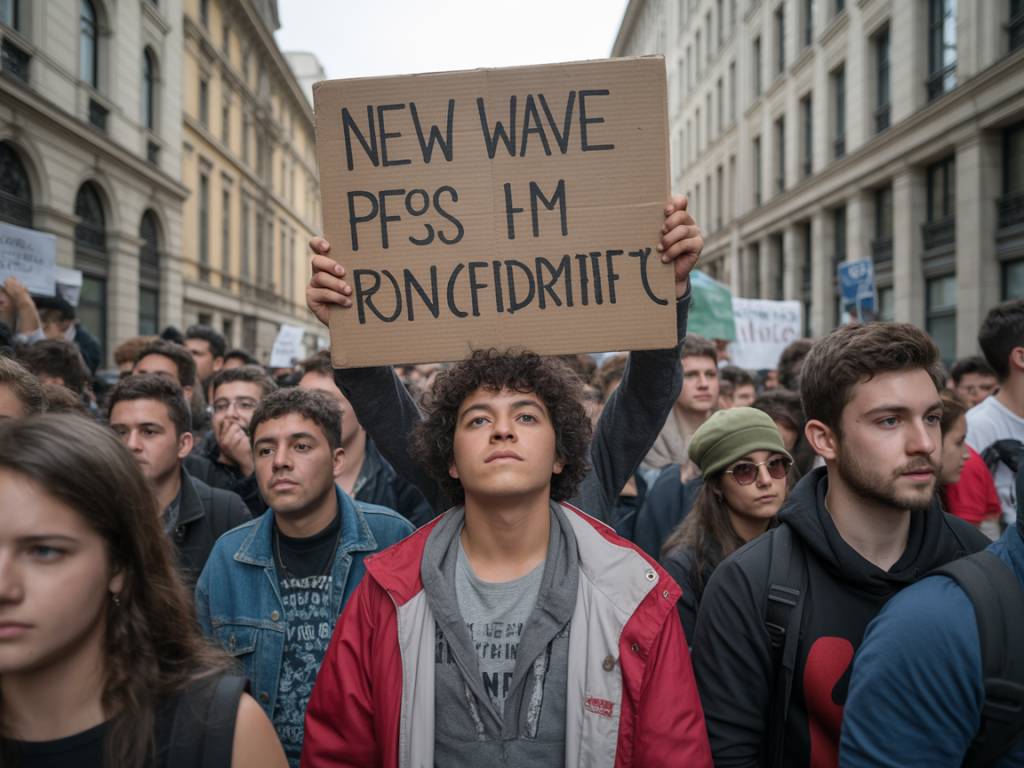
Across continents, a new generation is redrawing the lines between politics, business and society. From Nairobi to New Delhi, from Paris to Santiago, youth-led movements are blocking roads, flooding social media, organising boycotts and forcing governments to backtrack on reforms once jugés inévitables. These are not isolated outbursts. They form a pattern — and ignoring it has become a strategic risk for policymakers and corporate leaders alike.
From campus debates to systemic disruption
Street protests by young people are not new. What is new is their speed, their scale, and their ability to combine physical mobilisation with digital pressure and economic leverage.
In the past, campus activism could take months to sortir des amphithéâtres. Today, a hashtag can become a nationwide movement in 48 hours. A viral video can trigger a consumer boycott before a company’s crisis team has even met. A local grievance can morph into a referendum on an entire political system.
Several elements characterise this new wave of youth-led protests:
- Hyper-connectivity: Mobilisation now happens on encrypted messaging apps, short video platforms and forums that are difficult for authorities to monitor in real time.
- Issue stacking: Movements rarely focus on a single theme. Climate, corruption, police violence, inequality and gender rights are frequently intertwined.
- Flexible leadership: Instead of one identifiable leader, many movements use decentralised structures with spokespeople who can be replaced quickly if targeted.
- Economic pressure: Calls for boycotts, divestment or labour disruption are increasingly central to their tactics.
The result: protests are harder to anticipate, faster to diffuser, and more difficult to neutraliser with traditional tools of political communication or policing.
Why this generation is different
Demographically and économiquement, the current wave of youth activism rests on a specific context.
1. A demographic bulge, especially outside Europe
According to UN data, people aged 15–29 account for more than 25% of the population in Africa, the Middle East and parts of South Asia. In some countries, the median age is under 20. Yet youth unemployment in many of these regions exceeds 25–30%, and under-employment is even higher.
When a young, educated, urban population feels locked out of economic and political opportunities, the street becomes an alternative negotiation table.
2. Hyper-education meets under-employment
Across emerging economies, university enrolment has surged over the past 20 years. A larger share of young people understands macroeconomic policy, climate science or digital rights — and can publicly question official narratives.
But this “education dividend” has not always translated into stable, well-paid jobs. The mismatch between expectations and reality fuels frustration, particularly when corruption or nepotism are perceived as key barriers to advancement.
3. Radical transparency and institutional mistrust
Studies by Pew Research Center show young adults are consistently less trusting of governments, traditional media and large corporations than older cohorts. At the same time, they have unprecedented access to alternative information sources and investigative content.
Leaks, data visualisations and open-source investigations (for example, using satellite imagery or open financial records) make it harder to hide policy failures or corporate misconduct. Each scandal reinforces the conviction that “the system” is rigged — and that only direct pressure works.
4. A new protest toolkit
If the 1960s were the age of the megaphone, the 2020s are the age of the dashboard. Youth organisers use spreadsheets, collaborative docs and data tools to coordinate logistics, donations and legal assistance.
- Map-based apps indicate police presence or safe routes.
- Shared databases list pro-bono lawyers, doctors and journalists.
- Analytics from social platforms guide message testing and timing.
Protest is managed almost like a start-up: with KPIs (media coverage, legislative proposals, resignations), rapid feedback loops and constant iteration of tactics.
Case studies across continents
To understand how this new wave is transforming politics and society, it is useful to look at concrete examples — not as isolated cases, but as variations on a common pattern.
Latin America: inequality and the cost of living
In Chile in 2019, a modest increase in metro fares triggered massive demonstrations led, at first, by students. Within weeks, the protests had broadened into a nationwide challenge to a deeply unequal economic model. The outcome? A political agreement to rewrite the constitution, a process still in flux but unthinkable without sustained youth mobilisation.
In Colombia in 2021, tax reform proposals sparked large protests. Young people played a central role, using music, murals and creative occupations of public spaces. While the official trigger was fiscal policy, the underlying issues were youth unemployment, police violence and limited social mobility.
Africa: democracy, jobs and digital rights
In Nigeria, the #EndSARS movement against police brutality in 2020 quickly evolved into broader demands for governance reform. Young activists relied heavily on crypto donations when traditional banking channels were disrupted, illustrating the intersection of finance, tech and protest.
In Senegal and other West African countries, youth-led protests have pushed back against third-term ambitions of presidents and contested electoral processes. Again, the motives were not purely “political” in the narrow sense; they were intimately linked to economic prospects and perceptions of elite capture.
Europe: climate, cost-of-living and generational fairness
In Europe, where demographic trends are older, youth movements have focused strongly on climate and intergenerational justice. Fridays for Future, Extinction Rebellion and related initiatives have helped shift the Overton window: climate risk is now treated as a central economic variable by regulators, central banks and major investors.
More recently, the cost-of-living crisis has triggered mobilisation around housing, energy prices and student precarity. Rents that absorb more than half a young worker’s income become a political issue, not just a personal one.
Asia: democracy, freedoms and tech regulation
From Hong Kong to Thailand and India, youth-led movements have challenged constitutional changes, citizenship laws or limits on free expression. In many cases, organisers understand both the legal texts and the digital infrastructures behind new regulations on data, content or surveillance.
Their protest is not just about abstract freedoms; it is about who controls the code, the algorithms and the infrastructures that will shape future economic opportunities.
How these movements are reshaping politics
What has actually changed as a result of this wave of youth activism? More than headlines might suggest.
1. Parties and candidates are adapting their offer
Across democracies, traditional parties have been forced to adjust:
- Climate commitments are now standard in economic programmes, not annexes.
- Anti-corruption measures and transparency pledges appear in almost every manifesto.
- Young candidates are pushed forward as symbols of renewal, even when party structures remain largely unchanged.
Where mainstream actors have failed to adapt, new movements or outsider candidates have filled the vacuum — sometimes with progressive agendas, sometimes with more radical or nationalist platforms that also capitalise on youth discontent.
2. Policy timetables are accelerating
Governments are discovering that delaying contentious reforms can be more costly than confronting debates early. Youth-led protests have accelerated decisions on:
- Minimum wage increases and social protection expansions.
- Police and justice reforms, including body cameras and independent oversight.
- Climate-related regulations on fossil fuels, transport and housing.
Even where outcomes fall short of activists’ demands, the tempo of policy-making has shifted. Issues that once took a decade to move up the agenda now do so in a few years — or months.
3. Streets and platforms as parallel parliaments
In many countries, young people express low confidence in formal political channels but high confidence in their ability to influence public debate through protest and digital campaigns. Hashtags, viral videos and symbolic actions become tools to “vote” between elections.
This does not replace institutions, but it forces them to operate under continuous public scrutiny. Parliamentary debates are live-tweeted, fact-checked and memed in real time. A clumsy phrase can mobilise thousands in the streets the next day.
The implications for business and the economy
For companies, youth-led protests are no longer a distant “political” issue. They are a direct factor in operational risk, reputation and, increasingly, market access.
1. Consumer pressure and brand exposure
Young consumers expect alignment between corporate messaging and behaviour. Discrepancies are quickly exposed:
- A fashion brand promoting diversity while facing allegations of discrimination can face targeted online campaigns and physical store protests.
- Tech platforms that host misinformation or hate speech risk advertiser boycotts driven by youth-led coalitions.
- Energy or finance firms that sign climate pledges but continue high-emission projects become targets of coordinated actions, from peaceful occupations to shareholder activism.
What used to be a PR issue has become a strategic one. The cost of misalignment can include lost sales, talent drain and regulatory backlash.
2. Talent expectations inside organisations
Young employees often share the same values as protesters, even if they are not in the streets themselves. They expect their employer to take positions on social and environmental questions, or at least to justify clearly when it chooses not to.
Silence can be interpreted as complicity; vague commitments, as greenwashing or “purpose-washing”. Human resources, legal and communication teams must now work together to anticipate internal reactions to external crises — whether political, social or environmental.
3. Supply chain and site vulnerability
Factories, warehouses, retail outlets and offices can become symbolic targets if they are associated with contested policies, labour practices or environmental impacts. This is especially true in sectors such as mining, fossil fuels, fast fashion or platform work.
For multinationals operating in countries with strong youth movements, scenario planning must include protest-related disruptions: blocked facilities, reputational crises, sudden regulatory shifts. Insurers and investors are already integrating such risks into their evaluations.
How governments and institutions are responding
Faced with this new landscape, public authorities oscillate between three approaches: repression, co-optation and participation.
Repression: the short-term reflex
In some contexts, authorities respond with bans on demonstrations, internet shutdowns, arrests of leaders or new cybercrime laws used to curb online dissent. While these measures can temporarily reduce visible mobilisation, they often reinforce long-term mistrust and push activism into more radical or opaque forms.
Co-optation: including without transforming
Other governments have created youth councils, participatory platforms or advisory groups. These structures can be useful when they have real influence; they are counterproductive when they are perceived as purely decorative.
Young activists are quick to detect tokenism. A photo opportunity without substantive follow-up can trigger as much backlash as explicit repression.
Participation: shared agenda-setting
More promising experiments involve co-creation of policies. Citizens’ assemblies on climate, participatory budgeting processes in cities, digital platforms for law consultation — all these mechanisms give young people concrete levers beyond protest.
The key question is always the same: how far are institutions ready to share power, information and agenda-setting with younger generations?
What leaders and organisations can do
Ignoring youth-led protests is no longer an option. The real question for governments, companies and institutions is: how to engage constructively?
1. Invest in early listening, not late crisis management
- Monitor not only mainstream media but also youth-dominated platforms and forums, with clear ethical guidelines.
- Track weak signals (petitions, local campaigns, student union resolutions) that may indicate emerging fault lines.
- Include young staff or advisors in risk analysis to avoid blind spots.
2. Be transparent about trade-offs
Youth movements tend to react badly to vague promises. They are more receptive to clear explanations of trade-offs, supported by data, even when they disagree with the outcome.
- Publish impact assessments of major reforms or projects, including social and climate dimensions.
- Explain why certain demands cannot be met immediately, with timelines and measurable milestones.
- Open data where possible, so independent analysts can verify claims.
3. Create real participation channels
For public authorities:
- Integrate young representatives into policy design committees with voting rights, not just observer status.
- Use digital tools to crowdsource proposals and feedback, and report back publicly on how inputs were used.
For companies:
- Establish youth advisory boards with access to top management and a mandate to challenge decisions on sustainability, ethics and social impact.
- Offer structured dialogue with employee networks around key strategic shifts (automation, AI deployment, relocation, etc.).
4. Align words, budgets and incentives
Ultimately, credibility depends less on communication than on allocation of resources.
- If climate is declared a priority, capex and R&D must reflect this.
- If social justice is highlighted, executive bonuses should integrate measurable diversity, labour and community indicators.
- If digital rights are recognised as crucial, governance of data and AI must be strengthened accordingly.
Young activists read annual reports, sustainability disclosures and investor presentations. Gaps between discourse and practice rarely stay hidden.
What to watch in the next five years
The new wave of youth-led protests is not a temporary “phase”. Several dynamics suggest it will intensify and evolve.
- Climate and adaptation: As extreme weather events multiply, expect more litigation, direct action and policy demands led by young coalitions linking climate to housing, health and food security.
- AI and work: Automation and generative AI will reshape labour markets. Youth movements are likely to target not only governments but also tech firms seen as primary decision-makers.
- Debt and intergenerational equity: Public debt levels, pension reforms and housing costs will fuel debates on who pays for which crises, and under what conditions.
- Digital sovereignty and censorship: As states tighten control over online spaces, young users will experiment with decentralised tools, encryption and alternative platforms.
For political and economic decision-makers, the message is stark: the legitimacy of institutions will increasingly be tested by their capacity to integrate the demands, skills and energy of younger generations into concrete policies and business models — not just campaign slogans or CSR reports.
Youth-led protests are not merely a disruption to be “managed”. They are an early-warning system for structural tensions that, if ignored, become far more costly to address later. The organisations that will navigate this decade successfully are not those that avoid conflict at all costs, but those that are capable of learning from it, in real time, with the generation that will soon represent the majority of workers, consumers and voters.