


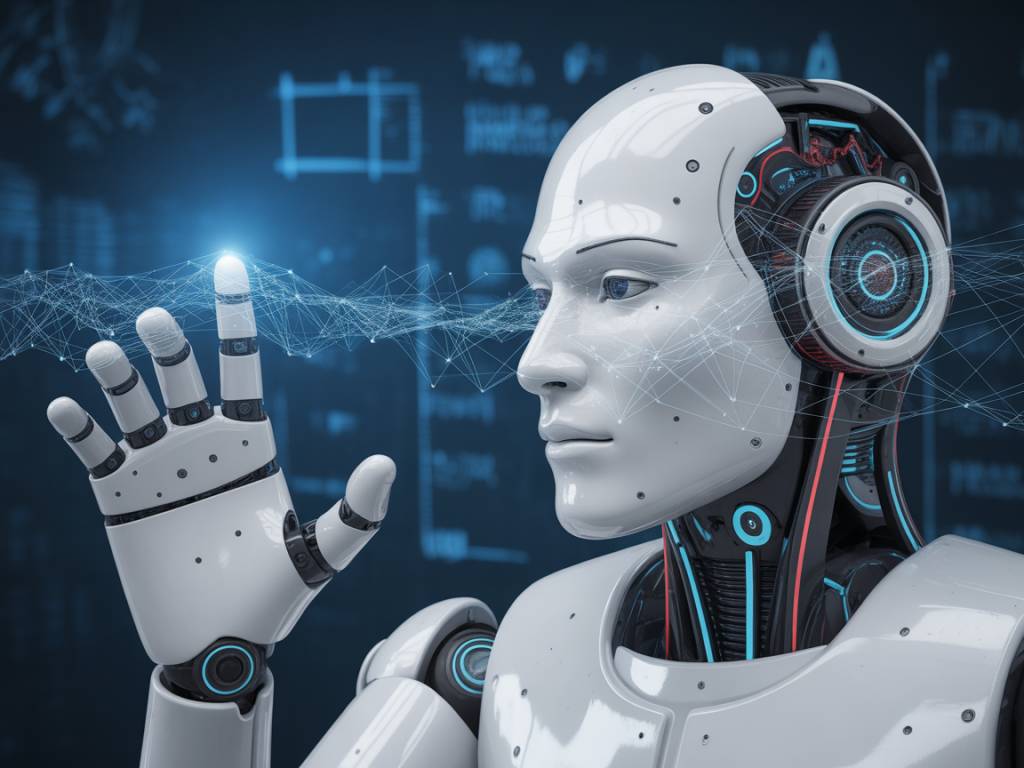
Artificial intelligence is no longer a lab experiment or a buzzword in boardroom slides. It is quietly rewriting job descriptions, redefining how teams innovate and, in many sectors, redrawing the competitive map. For companies, AI is becoming a new production factor, on par with capital and labor. For workers, it is both a risk of obsolescence and a lever for upgrading their role — sometimes simultaneously.
Rather than asking whether AI will “destroy jobs”, the more useful question is: how is it changing the way value is created, who captures it, and what this implies for organizations and individuals over the next five to ten years?
From automation to augmentation: what is really changing
AI is often presented as another wave of automation, in the lineage of industrial robots or office software. In reality, two shifts make the current moment different:
- Tasks, not jobs, are being automated: Large language models, vision systems or recommendation engines target specific segments of work — drafting, classifying, summarizing, detecting anomalies — rather than entire professions.
- Cognitive, not just manual work is affected: AI is attacking activities that were previously considered “too intellectual” to automate: coding, legal research, customer support, marketing copywriting, simple design.
In practice, this means that a lawyer, a salesperson or a project manager will not be replaced by an algorithm, but certain parts of their daily routine will be executed faster, cheaper and sometimes better by AI. The job is reconfigured around what remains: judgment, negotiation, relationship-building, domain expertise.
Companies that understand this shift treat AI as a tool for augmentation: they redesign workflows so that machines handle repetitive, scalable patterns, and humans focus on exceptions, supervision and value creation. Those that do not risk either over-automating (and destroying quality and trust) or under-automating (and losing competitiveness).
Which jobs and skills are being reshaped first?
Recent studies from the OECD, McKinsey and several central banks converge: the jobs with the highest exposure to AI share three characteristics:
- A large share of tasks that are information-based (emails, reports, analysis, calls, forms).
- Work that is structured and documented (procedures, standards, historical data).
- Limited need for physical presence or fine motor skills.
Concrete examples:
- Customer service: Chatbots and voicebots now handle level 1 support, FAQ, appointment booking and basic troubleshooting. Human agents are repositioned on complex cases, churn prevention and upsell.
- Marketing and communication: Drafting social posts, product descriptions or email sequences is increasingly delegated to generative AI tools, while marketing teams focus on strategy, positioning and testing.
- Software development: AI coding assistants (GitHub Copilot, etc.) can generate boilerplate code, tests and documentation. Developers spend more time on architecture, security and integration.
- Finance and risk: AI accelerates fraud detection, invoice processing, credit scoring and scenario simulations. Finance teams shift towards business partnering and decision support.
At the skill level, the frontier is moving quickly. Three families of competences gain importance across almost all sectors:
- Problem framing: The ability to formalize a business problem in a way that AI can tackle (data to use, constraints, metrics) becomes as critical as the technical implementation itself.
- Hybrid literacy: You do not need to become a data scientist, but understanding what AI can and cannot do, how models are trained, and where biases come from is now part of the baseline for managers.
- Human-centric skills: Negotiation, empathy, leadership, ethics, cross-functional collaboration — all the “soft skills” that AI cannot replicate easily become key differentiators.
In other words, the premium is shifting from knowledge per se to the capacity to mobilize knowledge, tools and people to solve problems in a dynamic environment.
How AI is transforming innovation inside companies
Beyond productivity, AI is reshaping the way companies explore, test and launch new products or services. Three transformations stand out.
1. From intuition-led to data-augmented decisions
In many organizations, decisions about new offers, pricing or features are still driven by seniority, gut feeling or internal politics. AI-driven analytics and experimentation platforms make it possible to:
- Test dozens of variants of a product page, email, or feature on small user samples before rolling out.
- Simulate demand, capacity and profitability under multiple scenarios.
- Detect weak signals in customer feedback, usage logs or social media.
This does not make intuition useless; it makes it testable. The most innovative companies combine leaders’ vision with systematic experimentation, reducing time-to-learn and cost of failure.
2. Lowering the cost of experimentation
AI significantly reduces the resources needed to go from idea to prototype:
- A designer can generate dozens of interface mock-ups in minutes.
- A marketer can validate several positioning options with synthetic copy, visuals and A/B tests.
- An engineer can build a functional demo with minimal manual coding.
This “cheap experimentation” favors cultures where teams are encouraged to test hypotheses quickly rather than spending months perfecting a business case. Startups have long operated like this; AI makes the model accessible to larger, more traditional players.
3. Opening new business models
AI also enables new ways of creating and capturing value. A few illustrative cases:
- Predictive maintenance allows manufacturers to move from selling machines to selling uptime or performance (service contracts based on availability).
- Personalization at scale lets retailers or media platforms tailor recommendations, prices or content to each user, increasing conversion and loyalty.
- AI-as-a-service models allow companies to monetize proprietary data or algorithms through APIs and platforms, creating new revenue streams.
These shifts are not purely technological. They require revisiting pricing, risk-sharing, contracts, governance and sometimes even the company’s identity. But the catalyst is clear: the ability of AI systems to learn from data and adapt in near real time.
Risks, tensions and the role of regulation
The upside of AI for productivity and innovation is real. So are the risks. For companies and workers alike, the main points of tension include:
- Job displacement and inequality: While AI creates new roles (ML engineers, prompt designers, AI product owners), it can compress mid-level positions whose tasks are highly codifiable. Without reskilling policies, polarization between “AI-augmented” and “AI-replaced” workers is likely.
- Opacity and bias: Many models operate as black boxes. When they are used for hiring, credit, insurance or justice, the risk of reproducing or amplifying existing discrimination is significant.
- Data privacy and security: AI systems need large, often sensitive datasets. Misuse, leaks or attacks can damage trust and expose companies to legal sanctions.
- Dependence on a few platforms: Relying heavily on a small number of AI providers creates vendor lock-in and strategic dependence, especially for critical sectors.
Regulators are moving, albeit at different speeds. The EU’s AI Act, for instance, classifies AI systems by risk level and imposes stronger obligations on “high-risk” applications (in HR, education, health, critical infrastructure). Other jurisdictions focus on sectoral guidance (financial services, health, public sector).
For companies, the message is clear: treating AI as a purely technical matter is no longer an option. Governance, transparency and ethical frameworks must be integrated from the design phase. For workers, understanding these rules — and their rights — becomes part of digital literacy.
What companies should do now
Between the alarmist speeches about “robots taking all jobs” and the triumphant promises of “10x productivity”, leaders need a pragmatic roadmap. Three priorities emerge for the next 12–24 months.
1. Map the work, not just the jobs
Instead of asking “Which positions can we automate?”, leading companies start with a much more granular question: “Which tasks in our processes could be partially or fully supported by AI, with what risk and what gain?” This involves:
- Decomposing key workflows (sales, support, finance, operations) into tasks.
- Evaluating each task by repetitiveness, value, risk and data availability.
- Identifying quick wins (low risk, high volume) and strategic bets (high value, more complex).
This exercise often reveals a simple truth: a significant share of white-collar work is still spent on copy-paste, reformatting, status reporting and basic synthesis — all areas where AI already performs well.
2. Build a responsible AI backbone
Experimenting with off-the-shelf tools is a start, but scaling AI requires a robust backbone:
- Data infrastructure: Clean, accessible, well-governed data lakes or warehouses.
- Security and compliance: Clear rules on what can be fed into external models, how outputs are validated, and how user data is protected.
- Governance: A cross-functional AI committee involving IT, legal, HR, business units and, ideally, worker representatives.
Some companies adopt “AI sandboxes” where teams can test use cases under controlled conditions, before industrializing those that demonstrate value and comply with internal policies.
3. Invest as much in people as in models
There is a temptation to treat AI as a capex line: buy tools, integrate APIs, expect ROI. The organizations that truly transform their productivity approach it differently. They:
- Train broad employee segments in “AI literacy”: capabilities, limits, risks, use cases.
- Create mixed teams (business, data, IT, legal) to co-design AI use cases.
- Adapt roles and incentives so that “working with AI” is recognized, not feared.
Some industrial groups, for instance, have introduced AI coaching for plant managers or sales leaders, showing how they can use tools to analyze performance, forecast demand or optimize schedules. The message: AI is not here to replace you; it is here to change how you lead.
What workers can do to stay ahead
For individual workers, the worst strategy is to ignore AI and hope it will not affect their job. The second-worst is to panic. The most effective approach lies in deliberate adaptation. Several concrete levers are accessible to most professionals.
1. Turn AI into your personal assistant
Start by identifying repetitive, low-value tasks in your week: drafting routine emails, summarizing meetings, formatting documents, simple research. Then test AI tools (within your company’s policies) to handle part of this workload. The goal is twofold:
- Free up time for higher-value activities (clients, learning, strategy).
- Learn, by doing, what AI is good at and where it fails.
Workers who systematically “delegate” parts of their tasks to machines often discover new ways to organize their day and to increase their scope of responsibility.
2. Strengthen your domain expertise
As generic tasks are more easily automated, deep domain knowledge becomes a key differentiator. AI can draft an average contract or marketing plan; it struggles to grasp the specificities of your market, regulation, internal politics or client history. Investing in:
- Industry trends and regulation.
- Your company’s products, processes and constraints.
- Your clients’ real pain points.
makes you more valuable in an AI-augmented environment.
3. Develop “AI collaboration” skills
Working with AI is often a dialogue: you formulate a request (prompt), evaluate the output, correct, iterate. This requires:
- Clarity in instructions: specifying context, constraints, style, format.
- Critical thinking: checking facts, detecting hallucinations, cross-validating with reliable sources.
- Curiosity: experimenting with different prompts and tools to discover new use cases.
In many office jobs, the ability to orchestrate AI tools will soon weigh as much as proficiency in office suites or email did in the previous decades.
4. Build a portable career narrative
If your current job is heavily exposed to automation, waiting for your employer or government to “save” it is risky. What you can build, however, is a coherent narrative around your transferable skills: problem-solving, project management, relationship-building, domain expertise, AI literacy. This narrative will matter for lateral moves, internal mobility and new roles that do not yet exist on job boards.
A new social contract around work and innovation
AI is not a destiny; it is a set of tools whose impact depends on choices made by companies, policymakers and citizens. We are not witnessing a purely technological disruption, but a renegotiation of the social contract around work, value creation and risk-sharing.
For companies, the central question is no longer “Should we adopt AI?” but “How do we design AI-enabled organizations that are both competitive and legitimate?” Productivity gains will be fragile if they come at the cost of trust — from employees, customers, regulators.
For workers, AI can be perceived either as a threat to defend against or as a new operating system to master. The difference often comes down to access to training, the quality of social dialogue and the capacity of managers to involve teams in the transformation rather than imposing it from above.
In the next decade, the most resilient ecosystems — sectors, regions, companies — will likely be those that manage to align three elements:
- Intelligent use of AI to increase productivity and accelerate innovation.
- Ambitious, concrete policies for reskilling and professional mobility.
- Robust, transparent governance of data and algorithms.
AI will not replace the need for strategy, leadership or human judgment. On the contrary, it raises the stakes for all three. The future of work and innovation will not be written by algorithms alone, but by the very human decisions about how, why and for whom these algorithms are deployed.