
 Bastien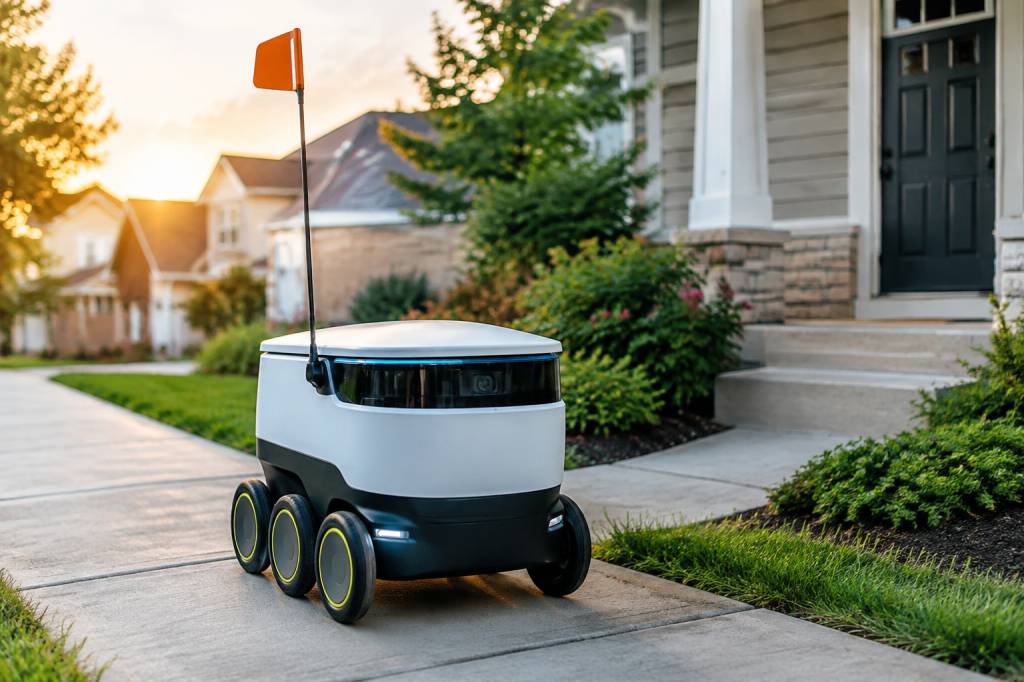
For years, the last mile of e-commerce was treated as a simple question of speed: how quickly can a parcel move from a warehouse to a customer’s door? That question is now being replaced by a more difficult one: how can deliveries remain fast, affordable and reliable when labour costs, urban congestion and customer expectations are all rising?
Amazon’s answer increasingly involves autonomous technology. Small delivery robots, warehouse machines, artificial intelligence and drones are being tested as part of a broader strategy to redesign the logistics network. The objective is not merely to put a robot on the pavement. It is to reduce the cost and complexity of each delivery while improving the company’s control over the supply chain.
Yet the reality is more nuanced than the futuristic images suggest. Amazon has tested autonomous delivery vehicles, paused some initiatives, expanded others and continued to rely heavily on human drivers. Robot delivery is progressing, but it is not replacing the traditional van fleet overnight.
Why the last mile has become a strategic problem
The last mile is the final stage between a local delivery station and the customer. It is also one of the most expensive and operationally difficult parts of e-commerce logistics.
A delivery van may carry dozens of parcels, but it must navigate traffic, parking restrictions, narrow streets, bad weather and unpredictable customer availability. A driver can spend only a few minutes at each address, yet those minutes accumulate across hundreds of stops. In dense cities, the cost per delivery can rise quickly.
Several pressures are making the problem more urgent:
- Higher labour costs: delivery networks require large numbers of drivers, especially during peak periods.
- Urban congestion: vans lose time in traffic and often struggle to find legal parking spaces.
- Customer expectations: same-day and next-day delivery have become standard in many markets.
- Environmental constraints: cities are introducing low-emission zones and limiting access for polluting vehicles.
- Demand volatility: sales peaks during events such as Prime Day and the holiday season create temporary capacity requirements.
Automation offers a potential response. If a robot can handle a short, predictable route from a local station to a nearby home, a human driver could focus on more complex deliveries. In theory, one van might transport several autonomous units to different neighbourhoods, improving productivity without removing the human element completely.
Amazon Scout: an ambitious experiment on wheels
Amazon’s best-known delivery robot project was Scout. Introduced publicly in 2019, Scout was a small, six-wheeled autonomous vehicle designed to move at walking speed on pavements and other pedestrian areas.
The battery-powered device was intended to carry parcels from a local delivery station to a customer’s home. Early field tests took place in the United States, including in suburban areas where pavements, road layouts and delivery distances were relatively manageable.
Scout was deliberately compact. It did not resemble a miniature delivery van. Its design aimed to fit within the space used by pedestrians while carrying a limited number of packages. Cameras, sensors and software allowed the vehicle to detect obstacles and navigate around people, bicycles and other objects.
The concept appeared straightforward: the robot would travel independently, stop near the destination and allow the customer to retrieve the parcel. But real streets are not controlled laboratories. A robot must deal with pets, children, construction work, parked cars, uneven pavements and pedestrians who do not expect an autonomous machine to pass by.
Amazon expanded Scout testing to additional locations, but the programme faced practical and commercial challenges. In 2022, the company reportedly reduced the project and reassigned employees while continuing to evaluate the technology. The decision underlined an important lesson: a successful prototype is not necessarily a scalable business.
The difficulty was not simply whether Scout could move autonomously. The larger question was whether it could do so cheaply, safely and consistently enough to compete with a human driver operating a van.
Why robot delivery is harder than it looks
Autonomous delivery combines several complex technologies. A robot needs to understand its surroundings, plan a route, avoid obstacles, communicate with a central system and handle unexpected events. It must also protect the parcel and reach the correct customer.
Navigation is only one part of the problem. Consider a typical delivery scenario: the pavement is blocked by roadworks, the building entrance is behind a locked gate and the customer is not at home. A human driver can make a quick judgement, call the recipient or leave the parcel according to company policy. A robot needs predefined rules, remote support or an alternative procedure.
Security creates another challenge. A delivery robot carrying valuable electronics or medicines could become a target for theft or vandalism. It may need cameras, alarms, geolocation systems and secure compartments. Every additional layer increases the cost and technical complexity of the vehicle.
Weather also matters. Rain, snow, ice and extreme heat can affect sensors, batteries and traction. A technology that performs well on a dry suburban pavement may be less effective in a city where surfaces are damaged or frequently obstructed.
Then there is the question of public acceptance. Will pedestrians tolerate autonomous machines on pavements? Will local authorities allow them to operate in busy areas? And who is responsible if a robot causes an accident? These are regulatory questions as much as engineering questions.
Amazon’s broader automation strategy
It would be misleading to look at delivery robots in isolation. Amazon is automating several stages of its logistics chain, from inventory management to warehouse operations and route planning.
Inside fulfilment centres, robots already move shelves, containers and packages. Amazon has also invested in systems that identify products, organise inventory and support employees during picking and packing. In 2023, the company announced technologies such as Sequoia, designed to improve inventory handling and make products available more quickly within fulfilment centres.
These systems can produce immediate operational benefits because warehouses are controlled environments. Routes are predictable, access is restricted and the company can standardise processes. The contrast with public streets is significant.
Amazon is also testing humanoid and advanced mobile robots for warehouse tasks. The partnership with Agility Robotics, for example, brought attention to the use of the Digit robot in fulfilment operations. Digit is designed to handle repetitive movements, such as moving totes, rather than delivering parcels directly to customers.
This distinction is important. The most visible automation may not be the last-mile robot seen on a pavement. It may be the less visible software and machinery that reduce handling time before a parcel even reaches a delivery station.
Drones: a different route to the customer
Amazon’s Prime Air programme represents another approach to autonomous delivery. Instead of travelling along streets, delivery drones use the airspace to transport lightweight packages over relatively short distances.
The potential advantage is clear. A drone does not need to deal with traffic, road closures or parking. It could deliver selected products rapidly from a local facility, particularly in suburban or rural areas where distances are longer and traffic is lighter.
Amazon has conducted Prime Air tests in the United States and received regulatory approvals for specific operations. However, drone delivery remains limited by several factors:
- Payload limits: drones can carry only relatively light packages.
- Weather sensitivity: wind, rain and poor visibility can disrupt flights.
- Airspace regulation: operations require authorisation and compliance with aviation rules.
- Landing conditions: the customer’s property must offer a safe delivery area.
- Noise and privacy: communities may object to frequent flights over residential areas.
Drone delivery is therefore unlikely to replace the standard van for a broad range of products. It is better understood as a specialised service for suitable locations, packages and delivery times.
The economics behind autonomous delivery
For Amazon, the business case depends on more than reducing the number of drivers. An autonomous system must justify its total cost, including hardware, software, maintenance, supervision, insurance, charging infrastructure and regulatory compliance.
A delivery van is expensive to operate, but it is flexible. A driver can carry hundreds of parcels, adapt to changing conditions and solve problems on the spot. A small robot may use less energy, but it carries fewer packages and may need remote human assistance.
The key metric is not simply the robot’s speed. It is the cost per successful delivery.
A useful autonomous system could create value in several ways:
- reducing the number of short vehicle trips;
- allowing delivery vans to serve as mobile launch points for smaller robots;
- extending delivery capacity during peak periods;
- lowering emissions in dense urban zones;
- improving delivery predictability for selected routes.
However, the economics can quickly deteriorate if every robot requires constant remote supervision. Automation does not necessarily eliminate labour; it may shift labour from driving to fleet monitoring, customer support, maintenance and exception management.
This is already visible in other technology sectors. Autonomous systems often reduce routine work while increasing the need for specialised technical roles. For logistics companies, the question is whether the productivity gains outweigh the new operational requirements.
What autonomous delivery means for workers
The rise of robots raises legitimate concerns for delivery drivers and warehouse employees. Last-mile logistics supports a large workforce, and any major automation programme could change the number and nature of available jobs.
In the short term, a mixed model is more realistic than full replacement. Human workers remain essential for loading vehicles, handling fragile or unusual packages, resolving delivery exceptions and interacting with customers.
Autonomous machines may first target the most repetitive parts of the job. A robot could handle a short route while a driver focuses on a larger vehicle or a more complex delivery area. In warehouses, machines can move heavy containers and reduce physical strain for employees.
That does not remove the need for workforce planning. Companies will need training programmes for technicians, fleet operators and supervisors. Regulators and local authorities may also ask whether productivity gains are being shared through better working conditions, higher skills and safer jobs.
Regulation and public trust will shape the market
Technology alone will not determine the future of robot delivery. Cities have to decide where autonomous machines can operate, how they should be identified and what safety standards they must meet.
Rules may cover speed limits, pavement access, remote intervention, data collection and emergency procedures. A robot equipped with cameras can improve navigation, but it also creates questions about surveillance and privacy. Customers may accept a camera on a delivery vehicle differently from a camera moving continuously through a neighbourhood.
Public trust will be built through small, visible successes. A robot that delivers reliably, yields to pedestrians and does not obstruct pavements is more likely to be accepted than a system introduced too quickly. Amazon and other operators will have to demonstrate that convenience does not come at the expense of safety or public space.
A hybrid logistics model is the most likely outcome
The future of Amazon delivery will probably combine several technologies rather than rely on a single autonomous solution. Human drivers, electric vans, warehouse robots, route-optimisation software, drones and small delivery vehicles may each serve a different role.
In dense urban areas, electric cargo bikes and compact vehicles may be more efficient than sidewalk robots. In suburban zones, an autonomous delivery device could serve a limited neighbourhood. In rural areas, drones may become useful for selected lightweight parcels. Inside fulfilment centres, robots can operate continuously under controlled conditions.
This hybrid model reflects an operational reality: different delivery environments create different problems. There is no universal machine that can navigate every street, carry every package and meet every customer expectation.
For businesses watching this evolution, several practical lessons stand out:
- Start with the environment: identify routes and tasks that are predictable enough for automation.
- Measure the full cost: include supervision, maintenance, insurance and infrastructure, not only the purchase price.
- Design for exceptions: human intervention remains essential when conditions change.
- Engage local authorities early: regulatory approval and community acceptance can determine deployment speed.
- Track customer experience: a technically efficient delivery is not successful if customers find it confusing or unreliable.
From futuristic image to operational tool
Amazon’s robot delivery experiments have attracted attention because they make automation visible. A small machine travelling down a pavement is easier to notice than an algorithm reorganising inventory inside a fulfilment centre.
But the lasting impact of autonomous technology may come from a more gradual transformation. Robots will not necessarily replace the entire delivery network. Instead, they may handle specific tasks, support human workers and make the supply chain more flexible.
The immediate question is therefore not whether robots will deliver every Amazon parcel. They will not. The more relevant question is where autonomy creates a measurable advantage: a short route, a controlled warehouse, a remote community or a peak-demand period.
Amazon’s experience with Scout shows that enthusiasm must be tested against economics, regulation and the realities of public space. Its continued investments in warehouse automation, artificial intelligence and drone delivery suggest that the company has not abandoned autonomous logistics. It is refining where and how the technology can work.
For the logistics industry, that may be the most important shift. The next generation of delivery will not be defined by one spectacular robot, but by the intelligent combination of machines, software and human judgement across the entire supply chain.